
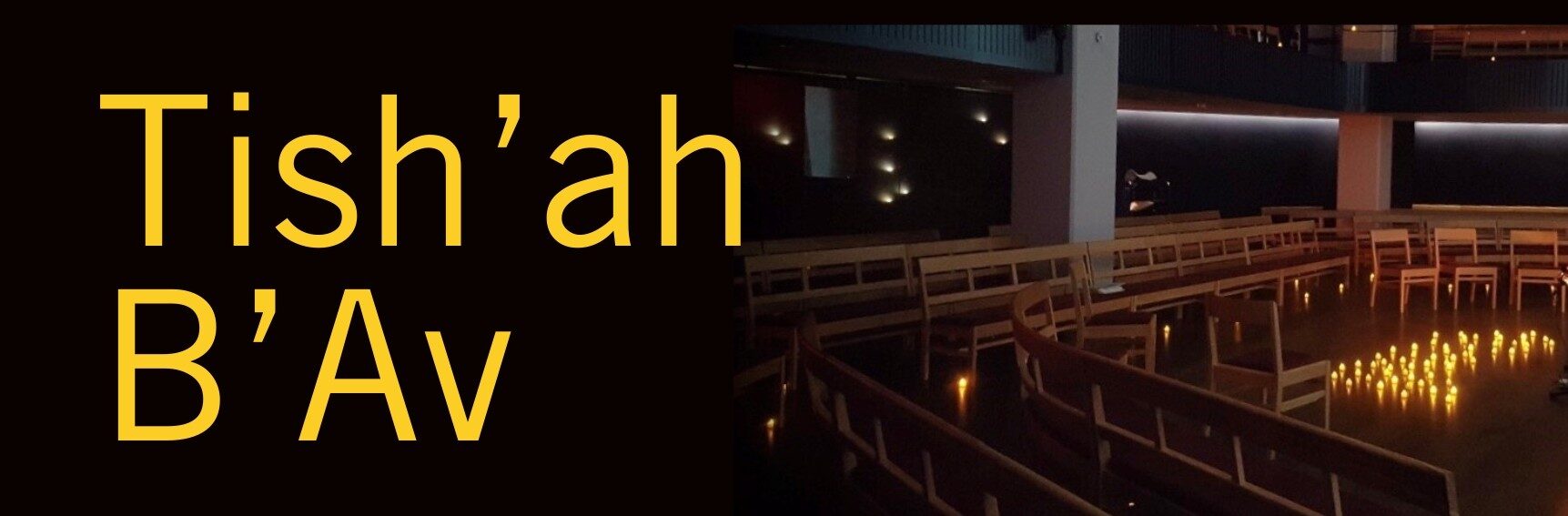
Tish'ah B'Av

Join us in-person at CBST, 130 West 30th Street, or via Zoom for Tish’ah B’Av Services, learning, and break fast.

עַ֥ל נַהֲר֨וֹת ׀ בָּבֶ֗ל שָׁ֣ם יָ֭שַׁבְנוּ גַּם־בָּכִ֑ינוּ בְּ֝זׇכְרֵ֗נוּ אֶת־צִיּֽוֹן׃

Al naharot Bavel sham yashavnu gam bachinu b’zochreinu et Tsion.
“By the waters of Babylon where we sat down, and there we wept as we remembered Zion.”
Psalm 137

Tish’ah B’Av commemorates the destruction of the First and Second Temples, along with a heartbreaking number of other tragedies in Jewish history. CBST’s Erev Tish’ah B’Av service is a special one. Contemplative, candlelit. Together, we remember, we mourn, and we turn our sackcloth and ashes into hope as we join in the tradition that this day is also the birthday of the messiah.

Tish’ah B’Av Ma’ariv and Eichah Reading

Wednesday, July 22 | 9 Av, 8:30pm I In-Person & Zoom

We open Tish’ah B’Av with the traditional reading of Eichah in a candle-lit service, commemorating the destruction of the Temple and other tragedies in Jewish history and in our day. Be with us in the Wine Family Sanctuary as we chant and read the Book of Lamentations. If you are on Zoom, you may choose to darken your space and sit on the floor, or as near to the floor as you are able, to make your space resemble a house of mourning.

Service Leaders and Ba’alei Tefillah: Rabbi Marisa James, Cantor Sam Rosen, and Larry Kay  


Tish’ah B’Av Minchah-Ma’ariv and Break Fast

Thursday, July 23 | 9 Av, 7:00pm I In-Person & Zoom

We begin with a special invitation to join Rabbi Marisa James for a Tefillin wrapping tutorial before Mincha. As we continue the holiday on the themes of the day with a Mincha service and Torah reading, and Ma’ariv service to conclude our 25-hour Tish’ah B’Av observance. Join for a full Kiddush Break-Fast. 

Service Leaders: Rabbi Marisa James and David Feinberg
D’var Torah: Rabbi David Elitzer
Ba’al Tefillah: Larry Kay

Tish’ah B’av Teaching 5786

As we find ourselves in the midst of the Three Weeks leading up to Tisha B’av, I find myself asking: am I ready for this? Am I ready for Lecha Dodi to the melody of Eli Tziyon, to sit in the dark and read the excruciating text of Eichah (Lamentations)? Am I ready to leave behind the joy of June? When Music Director Joyce Rosenzweig and I were planning the service for these weeks, we almost couldn’t believe that the Three Weeks were already upon us. It simply feels too early! Didn’t we just have an amazing Pride month and usher in the summer season? 

Part of me answers: 

“But this happens every year!” 
“Don’t you say that for every holiday, cantor?!”
“Jewish holidays are never early or late; they are always right on time!” 

But another part of me takes notice of a real difference: due to the confluence of the lunar and solar calendars it happens that this year, 5786, we celebrate Pride Shabbat and mark Tisha B’av within a thirty-day period (twenty-seven days this year.) That is more unusual than it is usual, but of course nothing is totally new. This last occurred in 2021 when there were only 23 days between our Pride Service and Tisha B’av (both on Zoom that year, of course.)  Usually we get more like five or six weeks, or more of separation. I am reminded that as a Jewish community, we’ve learned something important over the centuries: trust the calendar. We’ve been called People of the Book, but perhaps we should also call ourselves People of the Calendar. It’s ok if I’m not ready for Eli Tziyon just yet; the calendar reminds us that some discomfort is also ok, because it is the right time. Some are ready, others are not sure. 

Talk about a roller coaster! We come together for Pride and say: celebrate! Celebrate like your life depends on it. So we do what we do best, naturally. 

And this year, just shortly after, we receive another strong suggestion from our tradition: mourn. Mourn like your life depends on it. Like the velvet ropes in a museum, we are gently guided by our calendar to ritual, to history, to our humanity, and to each other. There was no AI involved in the making of this holiday or these traditions. We will dim real lights and set the real sanctuary as it has come to be set. The content was created centuries ago. We strain to hear and feel the echoes of so many difficult experiences and tragedies in Jewish history. And we feel the real pain of today. It’s ok if you don’t exactly know the destination or how to feel yet, because the journey is not an individual one alone. Trust the calendar, let the velvet ropes guide, and we will find our way. 

Cantor Sam Rosen

Further Reading

Eikha for the Earth
Rabbi Tamara Cohen and Rabbi Arthur Waskow offer an Earth-centered prayerful mourning/action/celebration.

The Joy of Tisha B’Av
Xava de Cordova on Tisha B’Av and the myriad faces of tragedy: grief, brokenness, laughter, and transformation.

Further text from two years ago (2023):

These afternoon and evening services for the close of the Tish’ah B’Av fast are the only ones organized by the Traditional Egalitarian Committee in July. It is customary to lay tefillin for the mincha service, because that is not done for the 9 Av morning service. Bring tefillin if you own a set. At the end of Ma’ariv, weather permitting, we go outside to read “Kiddush L’vanah,” or sanctification of the moon.

Tish’ah B’Av is preceded by a three-week mourning period beginning on the 17th of the month of Tammuz, the day when, according to the rabbis, the walls of Jerusalem were breached. This three week period began Thursday, July 6 on the English calendar. Traditionally this is observed as a somber time, when major celebrations do not occur. A period of more intense mourning begins with the beginning of the month of Av. Traditional practice for those nine days include refraining from eating meat, getting hair cuts, and other things the rabbis understood as expressions of luxury or celebration. This leads to Tish’ah B’Av, the second most significant fast day on the Jewish calendar, and the traditional restrictions echo those of Yom Kippur. Tish’ah B’Av is also marked liturgically, with three “Haftarot of Admonition” read on the three Shabbatot preceding the day, and seven “Haftarot of Consolation” read on the seven Shabbatot following Tish’ah B’Av. These lead us into the High Holiday season.