
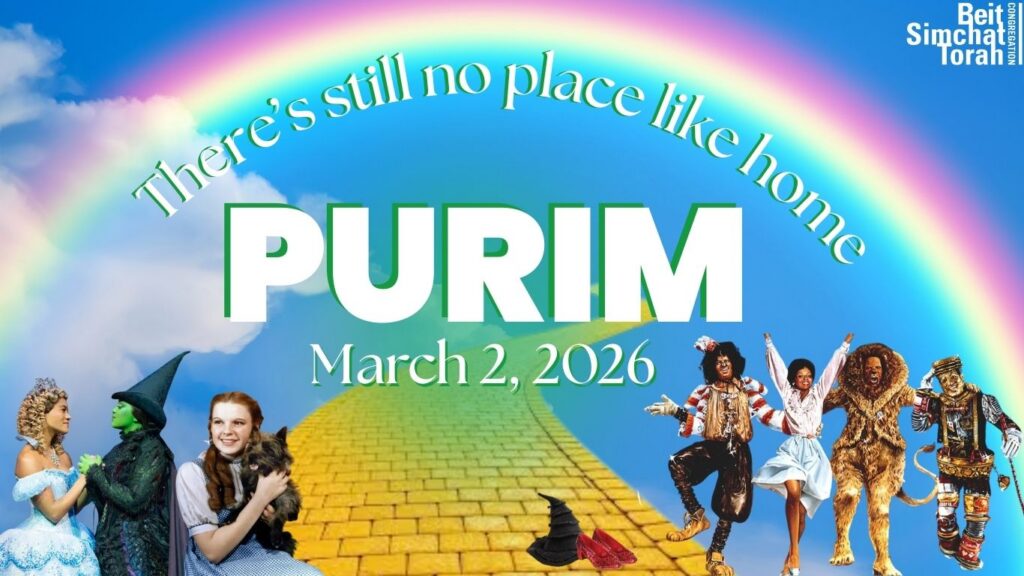
Purim Carnival!
Monday, March 2, 2026 | 5:00–7:00pm | In Person | Registration here
Follow the yellow brick road down to the Wolfson Lobby, where families can enjoy balloon animals, face painting (lots of pink and green available, and ruby too!), interactive arts and crafts, songs, and games throughout the evening, with plenty of other popular activities.
A performance designed especially for children and families will take place during the program led by Tkiya, followed by a singalong with our songleader, Rachel Chang.
An Emerald-City-worthy Dinner (Seudat Purim) from Chipotle, along with Wicked good snacks and treats, will be available. Vegan and GF items will be available.
Come in costume, whether as an Ozian, like Toto, Elphaba, our friend Dorothy, or the Mayor of the Munchkin City, or as someone else with brains, courage, and heart (Queen Esther, anyone?).
This event is recommended for kids ages 2–12 with their adult(s). Babies, toddlers, and teens welcome, too!
Families are welcome to stay after the carnival to join the broader CBST community over the rainbow (aka upstairs in the sanctuary) for the multi-lingual Megillah reading at 6:30pm, where we’ll give Haman the loathing he deserves. 
A Purim Teaching from Rabbi Yael Werber

In The Atlantic, Adam Serwer recently wrote that the movement in Minneapolis against ICE could best be described as “neighborism,” which is “a commitment to protecting the people around you, no matter who they are or where they came from.”
I was able to see this first hand while in Minnesota just a few weeks ago, when it was clear that the act of neighbors checking in on one another, stopping their cars to see how they could help, and quite literally being out in the streets protecting their neighborhood is what is keeping people’s spirits and hopes intact, and, even more importantly, keeping others safe.
I would like to suggest that the lesson of Purim is also one of Neighborism, or, at least, the holiday is a push for us to begin getting to know who is in our communities and how can we help each other.
This is most exemplified in two of the four mitzvot of the holiday: mishloach manot and matanot l’evyonim.
כַּיָּמִ֗ים אֲשֶׁר־נָ֨חוּ בָהֶ֤ם הַיְּהוּדִים֙ מֵאֹ֣יְבֵיהֶ֔ם וְהַחֹ֗דֶשׁ אֲשֶׁר֩ נֶהְפַּ֨ךְ לָהֶ֤ם מִיָּגוֹן֙ לְשִׂמְחָ֔ה וּמֵאֵ֖בֶל לְי֣וֹם ט֑וֹב לַעֲשׂ֣וֹת אוֹתָ֗ם יְמֵי֙ מִשְׁתֶּ֣ה וְשִׂמְחָ֔ה וּמִשְׁלֹ֤חַ מָנוֹת֙ אִ֣ישׁ לְרֵעֵ֔הוּ וּמַתָּנ֖וֹת לָֽאֶבְיֹנִֽים
“The same days on which the Jews enjoyed relief from their foes and the same month which had been transformed for them from one of grief and mourning to one of festive joy, they were to observe these as days of feasting and merrymaking, and as an occasion for sending gifts to one another and presents to the poor.
Esther 9:22
Mishloach Manot:
The commandment to share generously and joyously with one another is interpreted by the Hasidic master, the Sefat Emet, to be connected to the commandment from Leviticus of loving your fellow (or, as it is often translated, your neighbor) as yourself. It helps you come to a greater love of the people you connect yourself with, the people in your direct community, and a love for the greater people of Israel. The Sefat Emet then goes one step further and says, loving your neighbor includes a love for God, and giving mishloach manot will help you be in better connection with God, as well as those around you.
Matanot L’evyonim:
The Rambam writes, “It is better for a person to increase in giving gifts to the poor than increase in his festive meal or in the sending of portions to one another, because there is no greater joy than causing joy in the hearts of the poor, the orphan, the widow and the stranger. Causing joy in the hearts of those oppressed is similar to causing joy for the Presence of God.”
The grouping of these two mitzvot together helps to highlight the incredible mitzvah of knowing who you share both your immediate community with and also your larger one. In many ways, it is implicitly saying that, if you know your fellow community member and your neighbor, that you can help prevent the need for the violence of the Purim story to exist ever again. After all, if Mordechai and Esther were known and cared for by their neighbors, would the need for Purim even exist? Purim is a continual reminder every year that we must do better in taking off the masks we hide behind, and truly get to know one another.
It is often said that there is no mention of God in the purim story, but, much like today, it is clear to me that God is here. Not in the grand moments or even necessarily the heroic ones, but in the smaller, kinder moments of taking care of our neighbors, and our most vulnerable. In the moments of inviting others to eat with us, and finding ways to give to those who we don’t even know, because we know they have a right to be with their families.
This Purim, join in the spirit of Neighborism, and consider directing your matanot l’evyonim to The Ark’s mutual aid fund at the link below.